
Canada is buying sovereign drone capability. On whose autonomy stack?
#defense#drones#autonomy#procurement
David Olsson
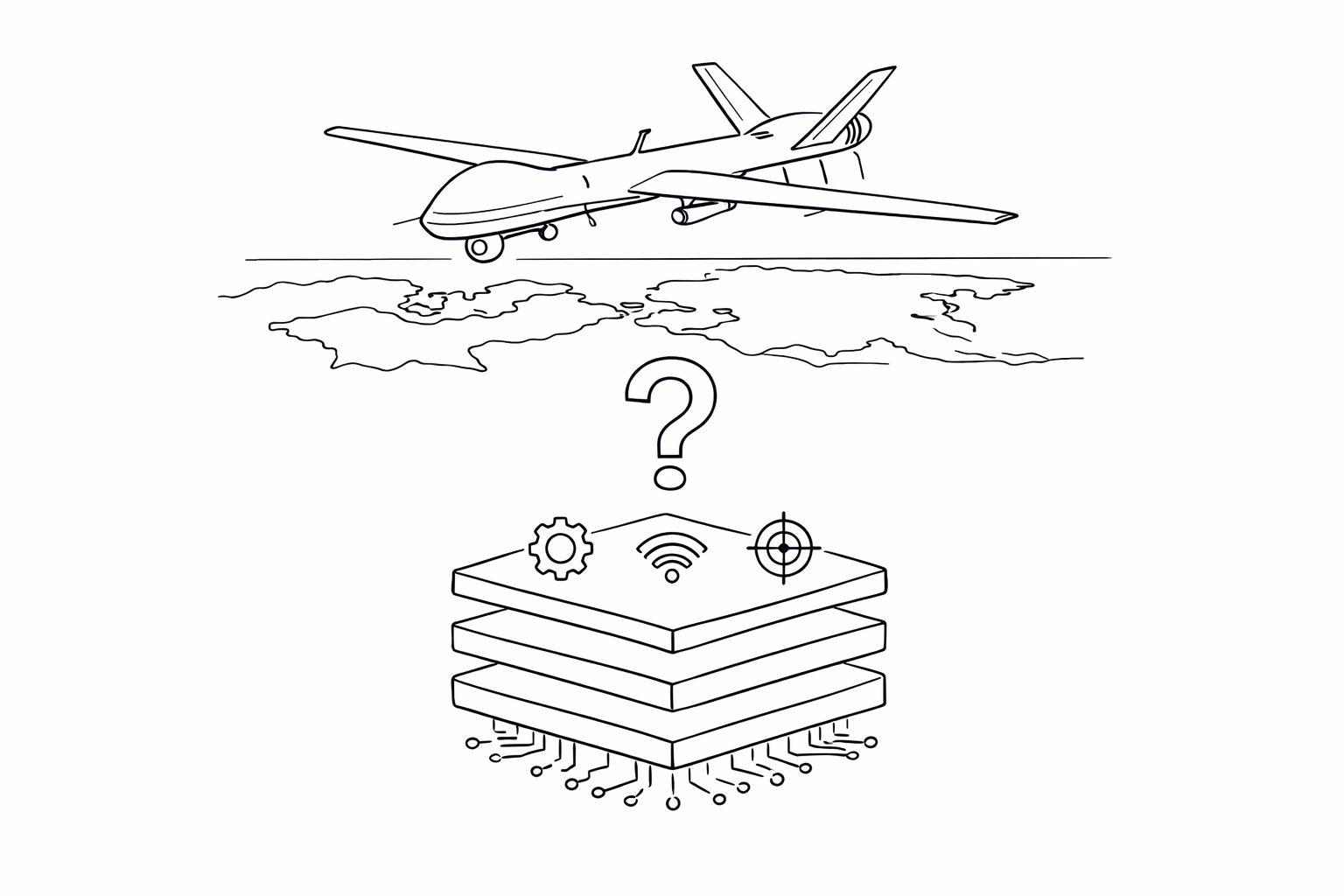
Canada is spending real money on uncrewed and autonomous capability — the kind of money that creates facts on the ground for a generation. What it has not yet published is who will own the intelligence inside it.
The National Research Council is investing over $900 million to stand up an autonomous-flight research facility, including the acquisition of a Bombardier Global 6500 and work on AI-enabled collaborative combat aircraft; coverage frames it as a national drone innovation hub for sovereign autonomous-flight capability. PacifiCan added $13.8 million for AI and aerospace defence innovation in B.C., including an AI-powered autonomous mapping drone system at the University of Victoria. A federal backgrounder ties AI-enabled capability acquisition to the Defence Investment Agency and the broader industrial strategy. The industrial base is moving too: Sentinel signed a partnership to supply autonomous drones to Ukraine. And from the Senate, Senator Hay argues that procurement must embed data-sovereignty criteria, warning that AI systems powering drones, intelligence platforms, and decision support run on data Canada must control.
The desk's read. Sovereignty of capability is not the airframe; it is the autonomy stack — the models, the training data, the targeting and navigation software, and the right to modify all of it without a foreign vendor's signature. A made-in-Canada drone running licensed foreign autonomy is a black box on a support contract with a maple leaf painted on it. None of the announcements above states where the human sits in the loop, whose foundation models the autonomy work builds on, or what the sole-source landscape looks like underneath the hub. Senator Hay has named the governance gap precisely, and so far it is an opinion piece, not a procurement criterion. The value-capture question rides along: $900 million buys either a domestic autonomy industrial base, or a market for integrating other people's autonomy into Canadian platforms. Which one is being purchased will be decided in contract clauses nobody puts in a press release.
The capability that matters is the one Canada can field, sustain, and modify without asking permission. That is the test. The announcements have not yet sat for it.
Sources: CBC · DroneLife · PacifiCan · Senator Hay · BetaKit — Sentinel · Defence Investment Agency backgrounder
This piece argues from the desk's stated editorial position. Reported facts trace to the sources above; the analysis is ours.