
More Than Weather
#kairair#vision#air-quality#building-in-public#manifesto#future
David Olsson
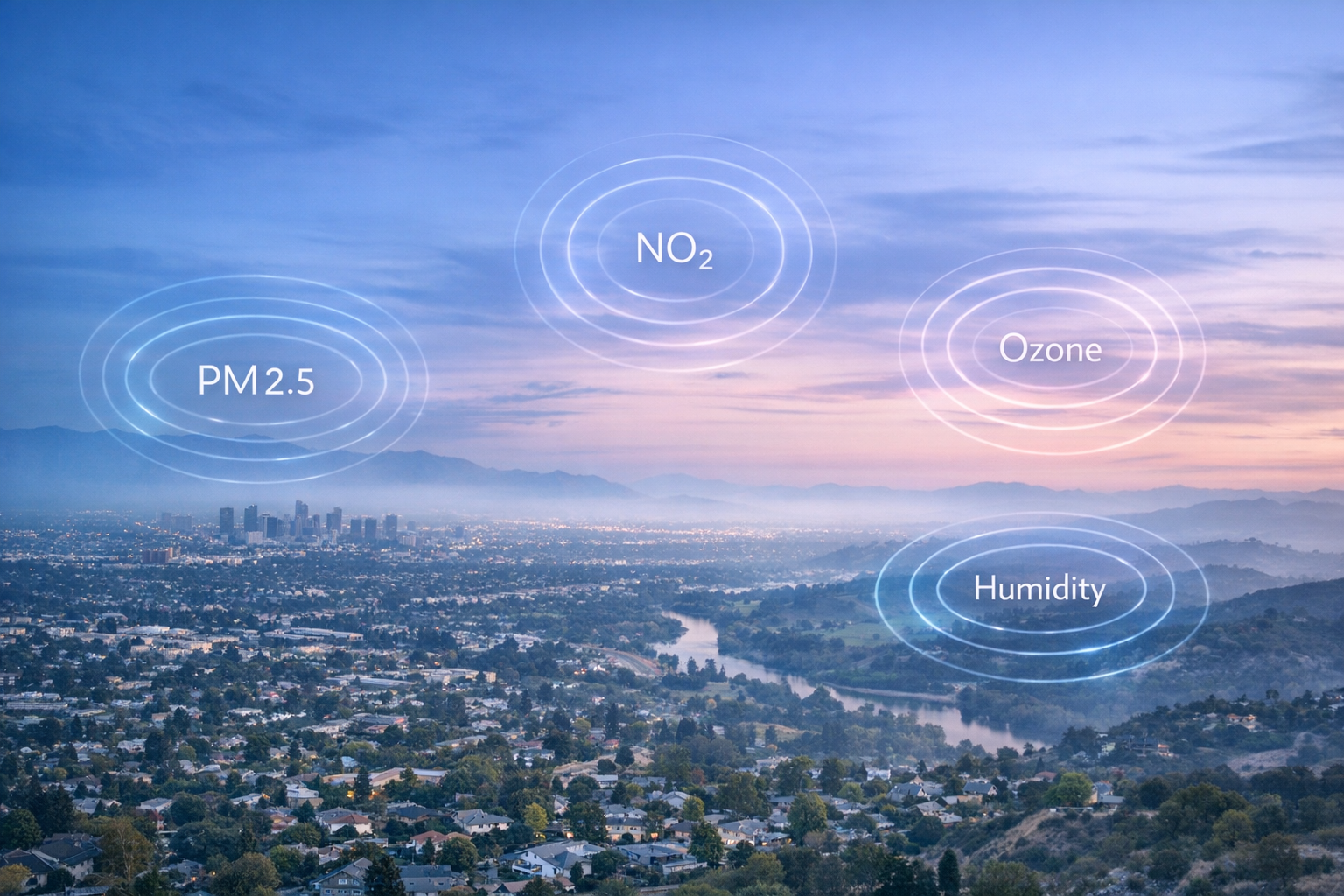
Eleven posts ago, I told you about a drawer of little boards that measured the air and told no one. This series has been the story of emptying that drawer — turning a pile of gadgets into a network, giving it a source of truth, a safe way to update itself, a way to be owned, a way to be felt.
All of it framed as weather. And it is weather, honestly and for now.
But I owe you the longer answer I've been holding back since the first post. Because weather was always the way in. It was never the destination.
the name was a clue
There's a reason it's KAIRair and not KAIRweather.
Weather is a subset of what the air is doing. It's the part we've named — temperature, humidity, pressure, the coming rain — because it's the part that's obvious, the part our bodies react to, the part we've been talking about since before we had instruments. Weather is air's most legible signal. It's the dialect of the atmosphere we all already speak.
Which makes it the perfect place to start, and a poor place to stop. Everyone has a relationship with the weather; nobody has to be sold on caring about it. So a network that begins with weather begins on ground people already stand on. But the medium — the actual thing every one of these stations is sitting in — is air. And air carries so much more than weather.
what else is in the air
Stand in a backyard and take a breath. Here's some of what you just moved through that no weather report mentions.
Pollen — the reason a spring day is glorious for one person and miserable for another, riding air currents the same way a cold front does, and just as mappable. Smoke — wildfire seasons that now redraw entire summers, where the difference between "go outside" and "stay in" is a particulate count nobody near you is measuring. Particulates — the fine stuff from traffic and industry and woodstoves that quietly shapes how healthy a place is to live, invisible and consequential. Sound — the acoustic texture of a place, its own kind of air-borne signal. And the ordinary, living traffic of an ecosystem: the air is not empty space between things. It's the thing itself, dense with information, most of it invisible to us because we never built the instrument to see it.
Weather is what we notice in the air. It is not what's in the air. Those are very different lists, and the gap between them is the whole opportunity.
a network shaped for the gap
Here's why the boring engineering decisions in this series matter more than they seemed to at the time.
Remember the dynamic sensor model — the one that captures a brand-new measurement the moment a station reports it, no schema change, no permission? That was never really about weather. Temperature and humidity didn't need a system that could absorb the unknown; we've known about them forever. That flexibility was built for the measurements not yet on the list. The day a station carries a pollen counter, or a particulate sensor, or something nobody's thought of, the network already knows how to catch it. It was designed, from the data model up, to grow past its own name.
Same with the source of truth that can describe any board and any sensor. Same with the experience layer that's a stage, not a fixed scene — ready to render whatever the air turns out to be doing. Same with the signed updates that let a fielded station learn a new capability without anyone touching it. None of that infrastructure is weather-specific. It's air-specific. Weather is just the first thing we pointed it at.
I didn't build a weather network that might someday do more. I built an air network that started with weather because that's where the trust and the familiarity are.
why this matters, plainly
Strip away the romance and here's the practical core.
The air is the most intimate environment we have — we're inside it every second, we can't opt out of it, and most of what it's doing to us is invisible. The measurements that would tell us the most about the air we actually breathe are exactly the ones that are hardest to find at the scale of a street, a yard, a neighbourhood. Official monitors are sparse and belong to institutions. The granular, local, personal picture of the air — the one that answers "is it okay for my kid to play outside right now, here" — mostly doesn't exist.
A network of owned, trusted, backyard sensors is the shape of the thing that could. Not because any one station is special, but because many of them, close together, owned by the people who live there, is how you make the invisible local. Weather proves the model. Air is the mission.
back to the drawer
So let me close where I opened.
The boards in that drawer each measured the air and told no one. That was the small, fixable sadness that started all of this — precision with no audience, a truth with no way to be heard.
The fix looked like a weather network. Underneath, it was something I believe in more than weather: the idea that the air around ordinary people, in ordinary backyards, is full of information that belongs to them and that nobody is currently helping them see. Weather is how we make that idea legible. It's the familiar frame around an unfamiliar ambition.
We're at ten stations, in calibration, measuring the weather in a handful of backyards. That's the honest present, and I won't inflate it. But the reason to build it carefully — the source of truth, the safe updates, the dynamic sensors, the ownership, the experience — is that this was never only going to be about whether it'll rain.
Weather is our context for the experience of air.
And air is full of life.
The drawer is empty. The network is listening. And there is so much more in the air than we've taught ourselves to hear — which is exactly the point.
The final post in the KAIRair build series. Start from the beginning: Air, Out Loud. If you want a station in your backyard, or want to build one, KAIRair is at kairair.com — an Atomic 47 Labs project, built with heart in Kelowna, BC.