
Sun, Battery, USB
#kairair#hardware#power#calibration#building-in-public#esp8266
David Olsson
Ask someone what the hard part of a weather station is and they'll guess the sensors. How do you measure temperature accurately, humidity, pressure, air quality.
Those are solved problems. You can buy a sensor the size of a fingernail that reads all four with laboratory-adjacent precision for a few dollars. The measuring is easy.
The hard part is the boring part: staying on.
A weather station's entire job is to be there tomorrow, and the day after, and next February at 3am when nobody's thinking about it, still reporting. A sensor that's perfect and a station that's dead is just a dead station. So most of the real engineering in a backyard station isn't about the air at all. It's about power.
And power is where the four station types come from.
why power is the whole game
An ESP8266 is a cheerful little radio that happens to have a processor attached. The radio is the expensive part — energetically speaking. Waking up, finding Wi-Fi, associating, sending a reading, and listening for a reply costs far more than the sensor read that prompted it.
That's the tension at the heart of every station: it wants to report often (so the network is live and useful) and it wants to sip power (so it survives). Those two desires pull in opposite directions, and where you land between them depends entirely on how the station is powered. A station on a wall outlet can report every breath. A station on a small battery has to be a monk about it.
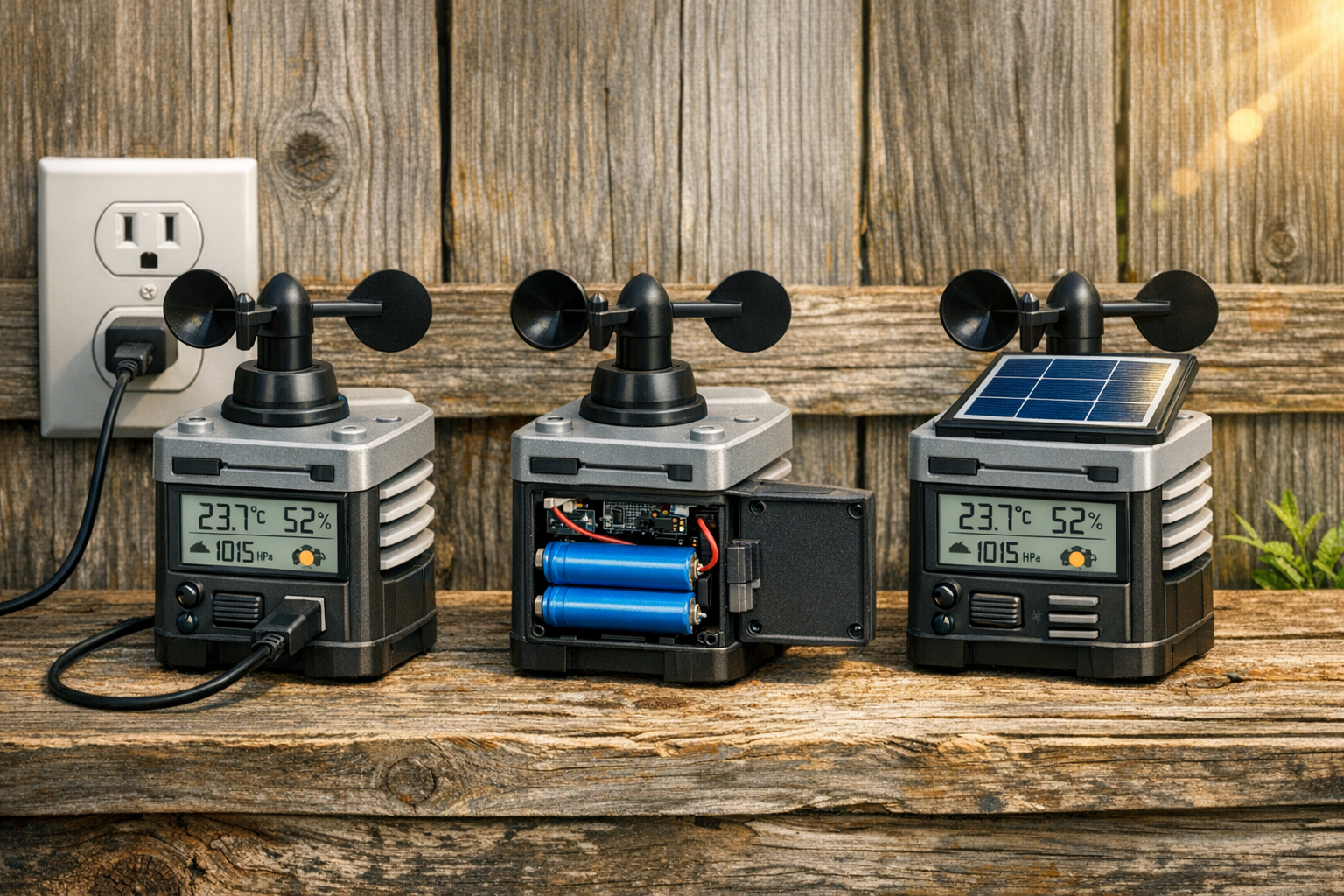
So "what kind of station is this?" is really the question "where does its power come from, and how carefully does it have to spend it?" Three answers, each a different kind of station.
USB: the honest baseline
The simplest station plugs into a wall.
A USB power adapter — the same brick that charges a phone — gives the station effectively unlimited energy. It never has to ration. It can keep Wi-Fi up, report frequently, drive the little OLED display continuously, and never once think about conservation. It's the most capable version of a station and the least interesting to engineer, which is exactly why it's the right place to start.
The USB station is the baseline — the control. When you're trying to figure out whether a reading is accurate, you want to eliminate every other variable, and "is it running low on power?" is a big one. A mains-powered station is always awake, always warm, always reporting. If it's wrong, it's wrong for an honest reason you can find.
It's also the friendliest station for a first-time host. Plug it in near a window, done. No batteries to worry about, no sun to chase.
battery: rationing on purpose
Cut the cord and everything changes.
A battery-powered station lives on a fixed energy budget and has to make it last. That means it can't stay awake — it has to sleep, hard, most of the time. Wake up, take a reading, send it, and go back to deep sleep for minutes at a stretch, drawing almost nothing in between. The reporting cadence stops being "as often as possible" and becomes "as often as the battery can afford."
It also means the station has to know how it's doing. A battery station that goes silent is ambiguous — is it broken, or is it just flat? So a battery station reports on itself, not only the air: its own voltage, its own charge state, so the network can tell "this one's fine" from "this one needs a hand." (There's a nice wrinkle here — the ESP8266 has exactly one analog input, so measuring your own battery is its own small engineering puzzle. A story for another post.)
The battery station is the one that makes KAIRair a network rather than a set of appliances plugged into walls. It can go where there's no outlet — the far corner of a yard, a fence post, a community garden.
solar: the station that refuels itself
Then there's the station that wants to run forever.
Solar is battery plus ambition. A small panel harvests light during the day, tops up a battery, and the battery carries the station through the night and the cloudy stretches. Done right, it's a station you install once and never think about again — it refuels itself.
Done wrong, it's the trickiest of the three, because now the station's survival depends on a weather-dependent power source in a place whose whole point is that the weather varies. A run of grey January days is exactly when you might lose a solar station — and exactly when you most want its data. Getting the panel size, battery size, and reporting cadence balanced so a station survives its worst week, not its average one, is the real work.
Solar is the station that makes the long-term vision plausible: air sensors that live outside, for years, without a cord and without a caretaker.
four types, ten stations, one word: calibration
USB, battery, solar — three power strategies. Cross them with the sensor loadouts a station can carry, and you get the first batch: ten stations across four types. Enough variety to prove the platform isn't secretly a one-board trick, few enough to actually build well.
And right now, all ten are in calibration mode, which is the least glamorous and most important phase of the whole project.
Calibration is the work of making sure the number a station reports is the number the air actually is. Two stations reading the same room should agree. A station that says 21°C should mean it. This matters more than it sounds, because a network's entire value is trust — the moment someone catches a station confidently reporting nonsense, they stop believing all of them. A network of confident, wrong readings is worse than no network at all, because it's misinformation with a nice map.
So before any of these ten go to hosts, they sit together, powered their various ways, and get checked against each other and against reference conditions. The USB baseline helps here — it's the steady ruler the battery and solar stations get measured against, so you can tell a real drift from a power-starved one.
Calibration is the gate. "Ready for hosts" isn't when the station turns on. It's when I'd trust its readings in your backyard as much as I trust them on my bench.
That's the standard the first ten have to clear. Not "does it work" — "is it right."
Part six of the KAIRair build series. Previous: Updating a Fleet You Can't Reach. Next: claimed, and private by default — why every station belongs to a person, and how privacy gets baked in (with more baking all the time).