
Weather You Can Feel
#kairair#experience#threejs#pwa#design#building-in-public
David Olsson
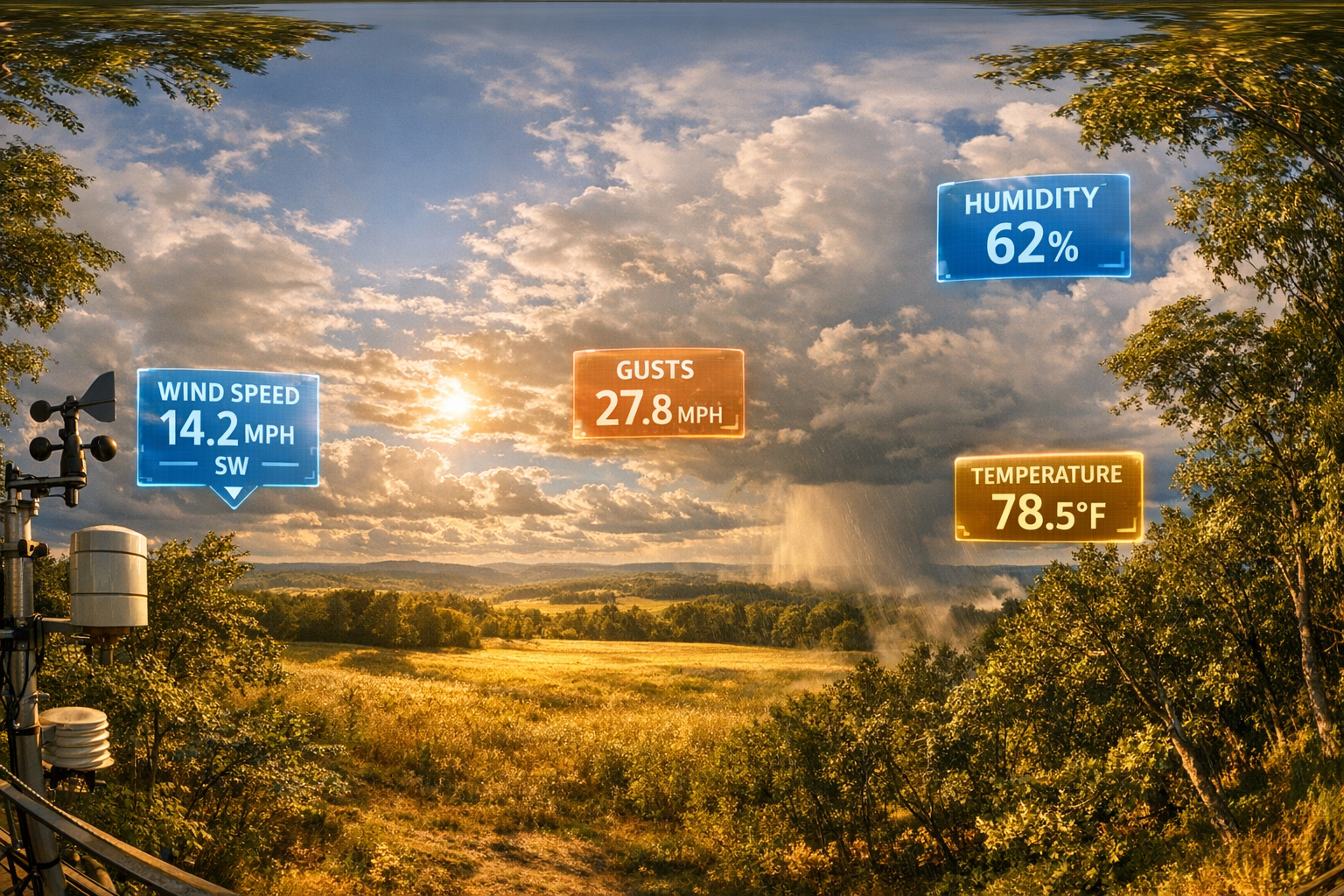
A number is a strange way to experience weather.
"4°C, 88% humidity, pressure falling." That's accurate. It's also nothing like what it's actually like outside — the flat grey light, the heaviness in the air, the sense that rain is coming before it comes. We translate weather into numbers to measure it, and in doing so we throw away the entire felt experience of it, which is the part people actually live in.
For most of this series, KAIRair has been a measurement system — get the number, get it right, store it, serve it. This post is about the layer that puts the feeling back.
every station has an experience
Alongside its data page, every station has a second face: a full-screen, immersive experience at its own URL. Not a dashboard. Not a chart. A scene.
You open it and you get a sky — a real-time, three-dimensional sky, rendered live in the browser, that is driven by that station's actual readings. Warm air and cool air don't look the same. High humidity hazes the air. Falling pressure — the signature of incoming weather — darkens and unsettles the scene. The sun sits where the sun actually sits, because the scene knows the station's location and the real time of day, so a station reporting at dusk shows you dusk, with the light low and gold, and a station at midnight shows you night.
It's built with real 3D graphics running right in the page, and it's designed to be ambient — something you'd leave up, glance at, feel. The goal was never "visualize the data." The goal was to make a person look at a screen and get, in their body, what the air in that backyard is doing right now.
installable, like an app
Here's the move that makes it more than a neat web page: you can install it.
The experience is a progressive web app — which is a technical way of saying you can add a station's scene to your phone's home screen and it behaves like a real app. Full screen, its own icon, no browser chrome, works when you open it cold. Tap the icon and you're looking at your backyard's live sky, as immediate as opening any other app, except this one is fed by a sensor you own sitting a few metres away.
No app store. No install friction. No forty-megabyte download. Just a station's experience, promoted to something that lives on your phone and shows you your own air whenever you glance at it. That's the ambient part made real — the network isn't a website you remember to visit, it's a scene sitting on your home screen, always current.
a scene is a slot, not a fixed thing
Now the architectural decision I'm proud of, because it's what keeps this from being a one-off.
The experience isn't hardcoded. There's a clean contract between the station's live state and the thing that renders it. On one side, the network produces a normalized picture of a station right now — its temperature, humidity, pressure trend, whether it's day or night there, where the sun is. On the other side, an experience is anything that knows how to take that picture and draw it, frame after frame, as the readings change.
That seam means the sky I built is just the first experience, not the only possible one. The same station state could drive a completely different scene — a minimalist one, a data-forward one, a playful one, something an artist makes that I'd never think of. Swapping the visuals doesn't touch the network; it's a different renderer plugged into the same live feed. The experience layer is a stage, and the sky is the first act.
I found this out concretely, and a little painfully, when I fixed the scene for phones. On a wide desktop screen the sun sat perfectly; on a tall phone screen it had wandered off the edge, because the camera hadn't been taught about portrait. A small, humbling bug — and a reminder that "make the air felt" is a real design problem with real craft in it, not a filter you drop on top of numbers. The scene has to work on the device that's actually in your hand, in the orientation you actually hold it.
why this belongs in a weather network at all
You could reasonably ask why a project this concerned with correctness and signed updates and calibration spends effort on a pretty sky.
Because measurement without experience is only half the point.
The whole thesis of KAIRair — the one I keep circling and will land in the final post — is that air is something we live inside, not just a dataset. A network that only ever produces numbers trains people to think of their air as an abstraction: a stat, a figure, someone else's chart. A network that also produces an experience does the opposite. It gives the reading back its body. It reconnects the 4°C to the grey.
And that reconnection is exactly what makes someone care enough to host a station, check on their air, notice when it changes. You don't fall in love with a number. You might fall a little in love with a live sky over your own backyard that shifts, honestly, as the real weather does.
The bench boards measured the air and told no one. The network measures the air and shows everyone. The experience layer does the last, human thing: it lets you feel it.
Part ten of the KAIRair build series. Previous: Your Air Is a Service. Next: calibration mode — an honest status report on the first ten stations, and what "ready for hosts" really has to mean.