
The AI That Conducts Your Interviews: OAIRA's Autonomous Interviewer
#interviews#AI#qualitative research#OAIRA#automation
David Olsson

The human moderator has been the bottleneck of qualitative research for decades.
Not because moderators are bad at their jobs — experienced qualitative researchers are exceptional. But because skilled moderation is expensive ($200-400/hour), difficult to scale, and impossible to run concurrently across hundreds of respondents. Qualitative depth and research scale have always been in tension.
OAIRA's Autonomous Interviewer resolves this tension.
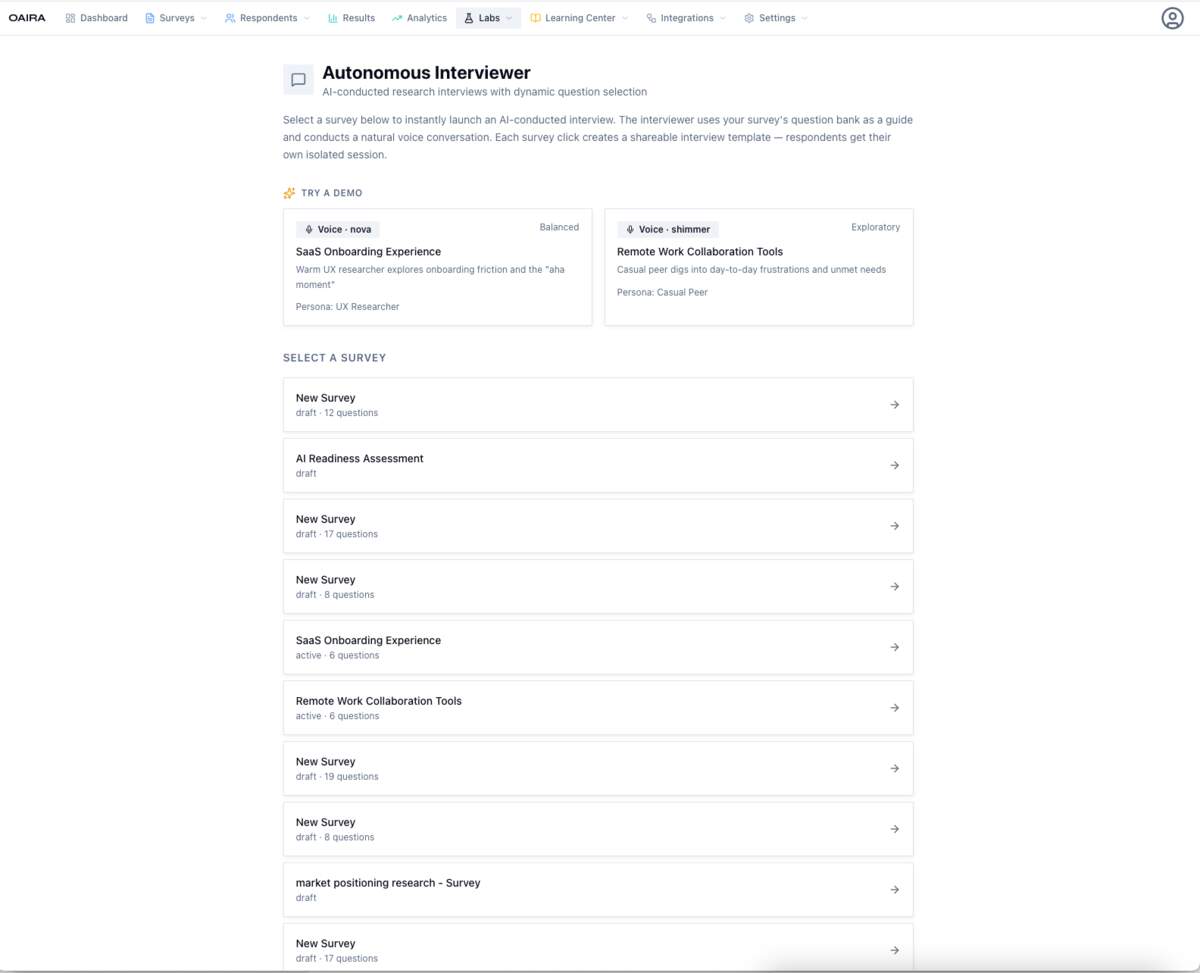
How It Works
The Autonomous Interviewer takes any existing survey as its starting point. The survey's question bank becomes the interview guide — not a rigid script, but a source of research intent. The AI interviewer uses it as a guide while conducting a natural conversational interview, adapting to what the respondent actually says.
Each respondent gets their own isolated session. One interview doesn't affect another. You can have dozens — eventually hundreds — running concurrently, each one a genuine qualitative conversation, each one building a complete response record.
The result is shareable: each survey click creates a shareable interview template that any respondent can access from their own device, in their own time.
Dynamic Question Selection
The key distinction between the Autonomous Interviewer and a chatbot reading from a script is dynamic question selection.
A scripted bot asks question 1, then question 2, then question 3 in order. The Autonomous Interviewer reads the conversation in progress and selects the next question based on what the respondent has already said, what's been covered, and what the research still needs.
If a respondent volunteers information that answers a later question, the interviewer doesn't ask it again. If a response opens up an unexpected thread worth following, the interviewer probes — just as a skilled human moderator would. If a respondent gives a thin or evasive answer, the interviewer follows up for specificity.
The interview is guided by research intent, not question order.
Configurable Interviewer Personas
OAIRA ships with two demo interviewer configurations, each with a distinct persona and voice:
Voice: Nova — Balanced "SaaS Onboarding Experience" A warm UX researcher exploring onboarding friction and the "aha moment." Persona: UX Researcher. Balanced in tone — probing but supportive, designed to surface friction without putting respondents on the defensive.
Voice: Shimmer — Exploratory "Remote Work Collaboration Tools" A casual peer digging into day-to-day frustrations and unmet needs. Persona: Casual Peer. Exploratory in approach — open-ended, conversational, designed to surface latent needs that structured questions miss.
Persona and voice aren't cosmetic choices. They shape what respondents are willing to say. A formal professional tone will get different answers than a peer-level casual conversation — especially on sensitive topics like frustration, failure, or unmet expectations.
Voice and Text Modes
The Autonomous Interviewer runs in both text and voice modalities. Voice mode uses the AI's configured voice (Nova, Shimmer, and others) to conduct the interview as a spoken conversation — respondents hear the interviewer and speak their responses.
Text mode is available for respondents who prefer it, or for research contexts where voice is impractical.
The same interview guide works in both modes. The transcript and response extraction work identically. You get the same structured data out regardless of the input modality.
What You Get
At the end of an Autonomous Interview session:
- A complete transcript of the conversation
- Structured response extraction — answers mapped to the survey's question schema
- Coverage tracking — which questions were addressed and how thoroughly
- The full session written to the survey's response database, alongside any other response modalities (standard survey responses, simulation responses)
This means interview data and survey data live in the same place, against the same question framework. Analysis doesn't require reconciling different formats or different data stores.
The Scale Implication
Qualitative research has historically been small-n. Ten interviews is a typical qualitative study. Twenty is ambitious. The constraint isn't methodological — it's economic. At $300/hour per moderator, fifty qualitative interviews costs more than most research budgets.
The Autonomous Interviewer changes the economic constraint without changing the qualitative nature of the method. You can run fifty interviews. You can run two hundred. The marginal cost of the fiftieth interview is the same as the first.
This doesn't replace the value of a skilled human moderator for deep strategic work. But it extends qualitative reach to sample sizes that were previously impossible — and it does so with an interview quality that far exceeds a static questionnaire.
OAIRA is an AI-powered market research platform. The Autonomous Interviewer is accessible in the Labs section and can be launched from any existing survey.