
Inside the Agent Registry: The AI Workforce Behind OAIRA
#agents#AI#architecture#OAIRA#engineering
David Olsson

Most software has a settings panel. OAIRA has an Agent Registry.
The distinction matters. A settings panel tells you how a feature is configured. An agent registry tells you who is doing the work — what instructions they're operating under, what model they're running on, and what their role is within the broader system.
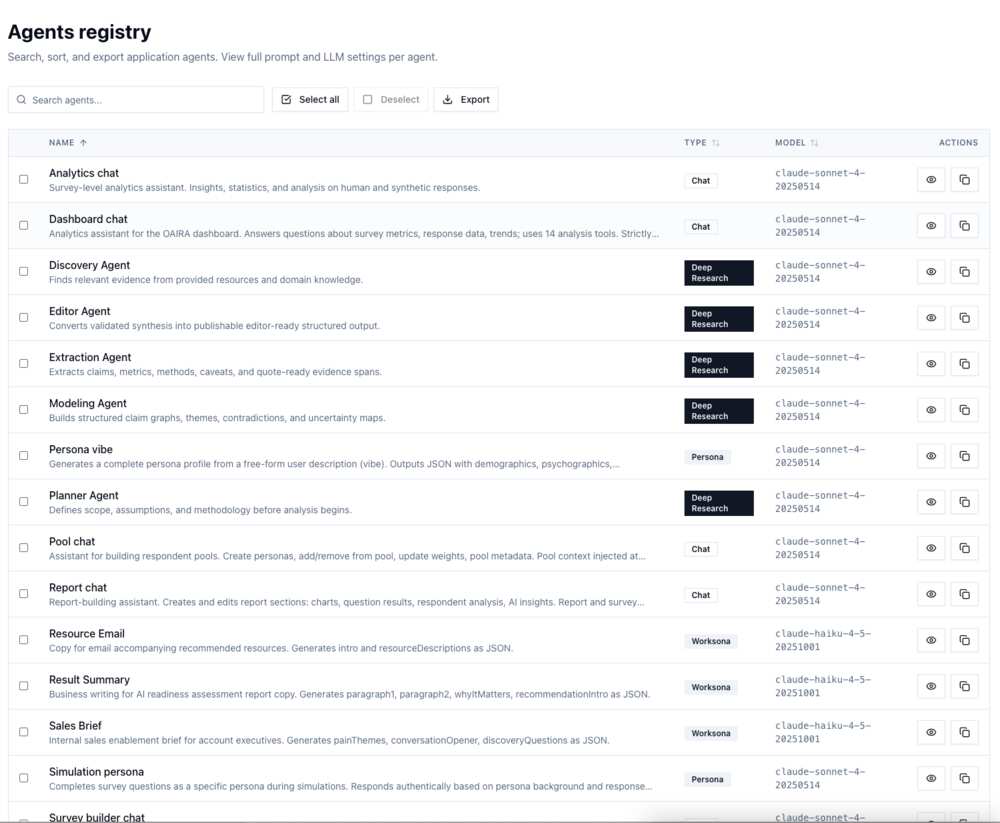
OAIRA's Agent Registry exposes every AI agent in the platform: searchable, sortable, inspectable, exportable. You can view the full system prompt and LLM settings for each one.
The Roster
At current count, OAIRA runs 14 production agents across five categories:
Chat agents — persistent assistants embedded in specific platform contexts:
- Analytics chat — Survey-level analytics assistant. Interprets statistics, analyzes human and synthetic responses, surfaces patterns.
- Dashboard chat — Analytics assistant for the main dashboard. Uses 14 analysis tools. Answers questions about metrics, response data, and trends across your entire research portfolio.
- Pool chat — Assistant for building respondent pools. Creates and manages personas, adjusts weights, updates pool metadata. Pool context is injected at runtime.
- Report chat — Report-building assistant. Creates and edits report sections: charts, question results, respondent analysis, AI insights.
- Survey builder chat — In-canvas assistant for survey creation and methodology guidance.
Deep Research agents — a multi-agent pipeline for synthesis-grade research:
- Planner Agent — Defines scope, assumptions, and methodology before analysis begins.
- Discovery Agent — Finds relevant evidence from provided resources and domain knowledge.
- Extraction Agent — Extracts claims, metrics, methods, caveats, and quote-ready evidence spans.
- Modeling Agent — Builds structured claim graphs, themes, contradictions, and uncertainty maps.
- Editor Agent — Converts validated synthesis into publishable, editor-ready structured output.
Persona agents:
- Persona vibe — Generates a complete persona profile from a free-form description. Outputs JSON with demographics, psychographics, and behavioral patterns.
- Simulation persona — Embodies specific personas during simulations. Responds authentically based on background and response styles.
Worksona agents (AI-powered content generation for business functions):
- Resource Email — Copy for emails accompanying recommended resources.
- Result Summary — Business writing for AI readiness assessment report copy.
- Sales Brief — Internal sales enablement briefs for account executives.
Inspectable by Design
Every agent entry in the registry shows:
- Name and description — what the agent does and where it operates
- Type — Chat, Deep Research, Persona, or Worksona
- Model — the specific Claude model version running this agent
- Actions — view the full prompt, duplicate the agent configuration
This isn't just an audit log. It's a design philosophy. When AI is doing real work in your platform, you should be able to see exactly what it's been told to do.
Most AI-powered products treat their prompts as black boxes. OAIRA treats them as first-class configuration, visible to platform administrators and exportable for review.
Agents as Platform Architecture
The registry reveals something important about how OAIRA is built: every distinct capability is an agent, not a feature.
Traditional software encodes logic in code paths — functions, classes, database queries. OAIRA encodes intelligence in agents — purposeful, named, instructed AI actors that operate within specific contexts with specific tools.
This means:
- New capabilities are new agents, not new code branches.
- Behavior is configurable at the instruction level, not just the parameter level.
- Multiple models can coexist — heavy analytical tasks on Claude Sonnet, high-volume generation tasks on Claude Haiku, each calibrated to the work.
- The system is auditable — you can always trace an output back to the agent that produced it.
The Agent Registry is where you see this architecture directly.
The Right Model for the Right Job
One thing the registry makes visible is deliberate model selection. Not every agent needs the most powerful (and most expensive) model.
- Deep Research agents and most Chat agents run on
claude-sonnet-4-*— capable of complex multi-step reasoning and synthesis. - Worksona agents run on
claude-haiku-4-5-*— fast, cost-efficient, calibrated for structured content generation where reasoning depth matters less than throughput.
This isn't cost-cutting. It's right-sizing. A sales brief doesn't need the same reasoning depth as a deep research synthesis. Treating every agent identically would be both wasteful and architecturally naive.
What This Means for Research
The Agent Registry isn't a product curiosity. It's evidence of a different kind of platform.
In traditional MR software, features are opaque. You use the report builder; you don't know what logic generates the output. You run the analysis; you don't know what statistical assumptions are built in.
In OAIRA, every AI behavior is documented, named, and visible. The agents doing the work are the features. And they're all in the registry.
OAIRA is an AI-powered market research platform. The Agent Registry is accessible to platform administrators under Settings.