
Realtime Voice Research: When Your Respondents Just Talk
#voice#interviews#AI#OAIRA#qualitative research
David Olsson
The most natural way for people to share their experiences is conversation. Not forms. Not checkboxes. Not a 1-10 scale.
People talk. And when they talk, they say things they would never write down in a text box — specific details, emotional texture, contradictions they don't even notice they're making. The gap between what people select on a survey and what they actually think can be enormous.
OAIRA's Realtime Interview closes that gap.
Powered by OpenAI Realtime
The Realtime Interview is built on OpenAI's Realtime API — a low-latency speech-to-speech pipeline that enables genuine back-and-forth conversation with an AI interviewer. This isn't voice-to-text that feeds a text chatbot. It's a continuous audio stream, processed and responded to in real time, with the conversational feel of talking to a person.
Latency is the critical parameter here. Research conversations need to feel like conversations, not like speaking into a phone tree. OpenAI Realtime's architecture keeps response latency low enough that the interaction feels natural — the AI responds when you finish speaking, not after a noticeable processing pause.
The Respondent Experience
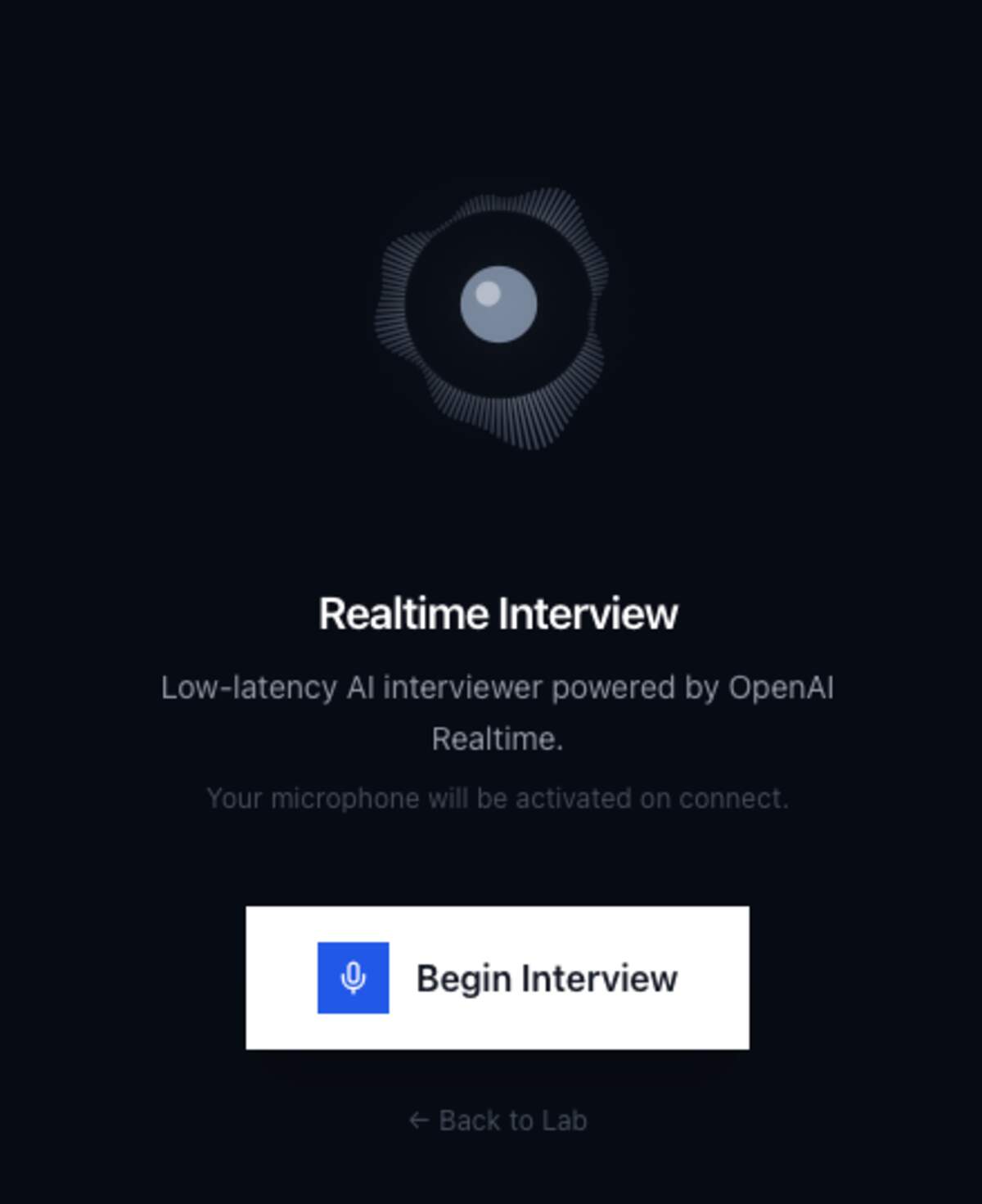
The interface is intentionally minimal: a pulsing visual indicator, a single button. "Begin Interview."
No login required. No lengthy instructions. No form to complete before you start. You arrive at the interview URL, click Begin, and start talking.
Your microphone activates. The AI interviewer greets you and begins. The rest is conversation.
This matters enormously for response quality. Every friction point between a respondent and the actual interview reduces completion rates and introduces selection bias — the people who complete complex interfaces are different from the people who don't. A single button eliminates that friction almost entirely.
What Voice Gives You That Text Cannot
Voice research captures signals that text simply cannot:
Spontaneous detail. When speaking, people naturally include examples, anecdotes, and context they would never bother typing. "The worst part is..." followed by a specific story is research gold. In a text box, most people write three words.
Hesitation and emphasis. A respondent who pauses before answering a question about switching behavior is telling you something. A respondent who answers immediately and emphatically is telling you something different. Voice preserves these signals; text erases them.
Natural correction. People speaking will contradict themselves, catch the contradiction, and self-correct. This is valuable data about complexity and ambivalence. Text respondents edit before submitting — the corrections disappear.
Emotional register. Frustration, enthusiasm, uncertainty, confidence — these are audible. They're not always recoverable from the words alone.
Transcript and Structured Extraction
The voice conversation is fully transcribed. Structured answers — mapped to the underlying survey's question schema — are extracted automatically.
This means voice interview data is not a separate corpus of unstructured audio. It flows into the same response database as standard survey completions, with the same question-level structure. Analysis treats voice responses and form responses identically, unless you specifically want to filter by modality.
Research teams that want the qualitative depth of conversation without the operational complexity of qualitative analysis get both: the richness of a spoken interview, the structure of a survey response.
The Research Modality Stack
OAIRA's voice interview is one modality in a stack:
| Modality | Best for |
|---|---|
| Standard survey | Large-n quantitative, fast completion |
| Text interview | Thoughtful, async qualitative |
| Voice interview | Natural conversation, emotional signal, higher depth |
| Realtime voice | Lowest latency, most conversational, widest accessibility |
Different research questions warrant different modalities. An NPS study doesn't need voice. A study of customer frustration during onboarding almost certainly does.
OAIRA lets you match the modality to the question, rather than constraining every study to the same format.
The Access Question
Voice research has historically required a human moderator to be present — scheduling, recording, transcription, analysis. The fully autonomous voice interview changes the access model entirely.
A respondent can complete a Realtime Interview on their phone, in their car, during their commute. At 7am before work or 10pm after the kids are in bed. In five minutes if the questions are focused, or in twenty if they have a lot to say.
The researcher doesn't have to be there. The quality is consistent across sessions. The data arrives in structured form, ready for analysis.
Voice research, at the scale and accessibility of a web survey.
OAIRA is an AI-powered market research platform. The Realtime Interview is available in the Labs section and uses OpenAI Realtime for low-latency voice conversations.