
WebSummit Crowd: 3D Agent-Based Conference Crowd Simulation
#worksona#simulation#three-js#agent-based#conference#visualization
David Olsson
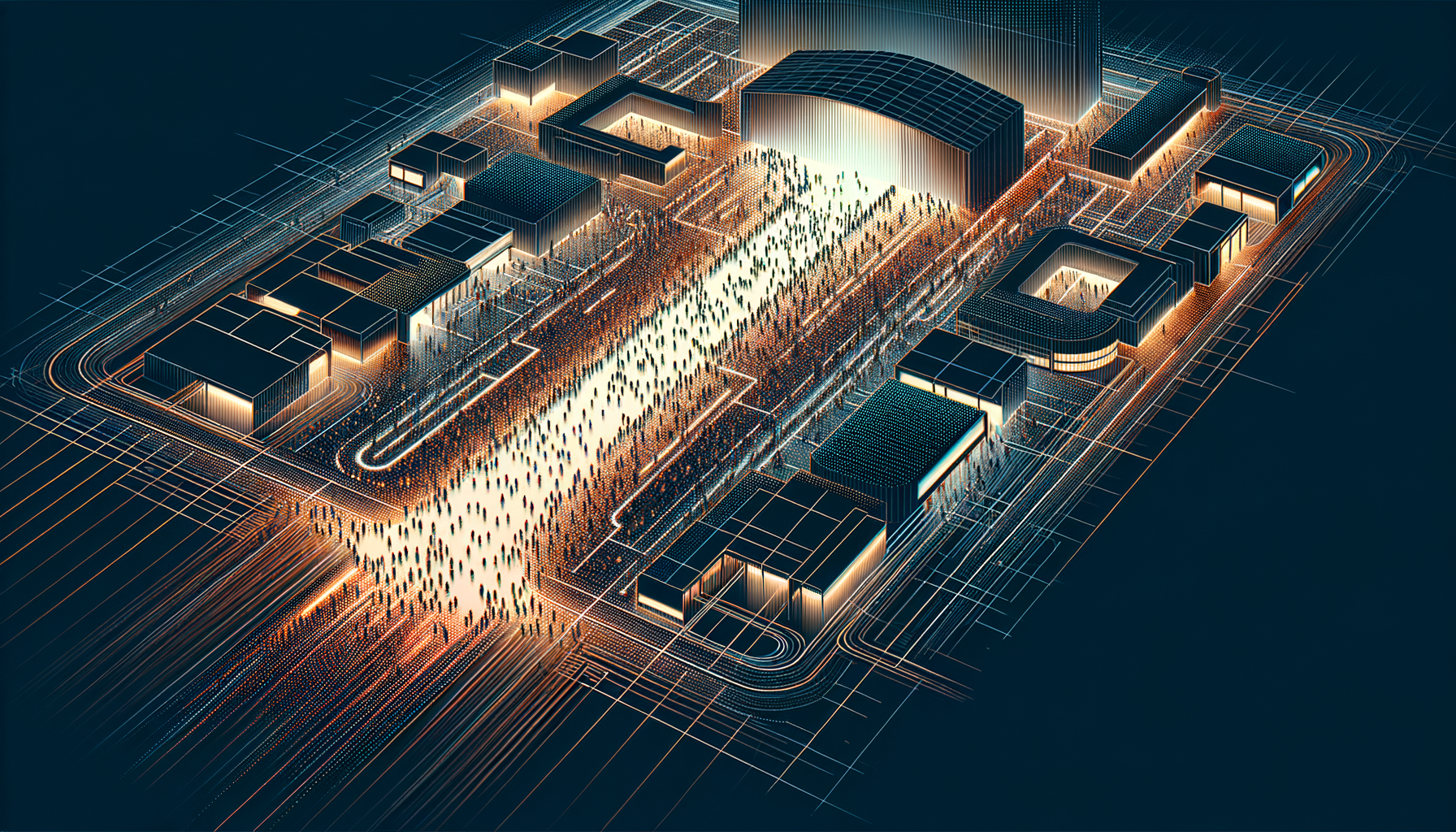
WebSummit Crowd is a React 18 + Three.js browser simulation of a conference floor populated by 3D agent-based attendees. Ten distinct persona types — Startup Founder, Investor, Enterprise Buyer, Developer, and six others — navigate the space according to programmed behavior rules: networking, attending talks, visiting booths, taking breaks.
Each persona type has a distinct behavioral weight profile. A Startup Founder prioritizes networking. An Investor splits attention between booths and networking. A Developer tends toward talk attendance. These weights govern how each agent allocates time across the available zones on the conference floor.
Recharts panels display real-time population distribution and movement analytics. Dexie.js persists session data. An AI chatbot panel accepts natural language queries about current crowd state — which zones are congested, how many investors are at the main stage, and similar operational questions. The application is built with Babel Standalone and requires no build step.
Why is it useful?
Conference organizers and venue designers need to model foot traffic, identify congestion points, and test session scheduling decisions before an event. Traditional approaches rely on historical counts from past events or manual estimation. Neither method handles novel venue configurations or significant changes to the session schedule.
Agent-based simulation makes behavior emergent rather than scripted. Each persona follows its own priorities, and macro patterns arise from micro interactions — queues forming at registration, clustering at sponsor booths during networking blocks, flow patterns shifting when a keynote ends. These patterns cannot be read off a spreadsheet; they have to be observed from the aggregate behavior of many agents following simple local rules.
Because the simulation runs entirely in the browser, stakeholders can explore scenarios in a meeting without deploying specialized simulation software. The AI chatbot panel lowers the barrier further — a non-technical stakeholder can query the current simulation state in plain language rather than reading charts.
How and where does it apply?
The primary application is event planning and venue layout optimization. Organizers can test different booth placement configurations and observe how foot traffic distributes across the floor for a given attendee mix. Sponsor booth placement strategy benefits directly — the simulation surfaces which floor zones attract which persona types under different scheduling assumptions.
Session data exported from Dexie.js provides dwell time by zone and persona type, which feeds post-simulation statistical analysis. The system also serves as an accessible demonstration of agent-based modeling principles in an applied context that non-specialists find immediately legible.
const PERSONA_CONFIGS = {
  startup_founder: {
    networkingWeight: 0.7,
    talkAttendanceWeight: 0.2,
    boothVisitWeight: 0.1,
    movementSpeed: 1.4,
    color: 0x4A90D9
  },
  investor: {
    networkingWeight: 0.5,
    talkAttendanceWeight: 0.1,
    boothVisitWeight: 0.4,
    movementSpeed: 0.9,
    color: 0x2ECC71
  }
};
The weight profiles are the primary tuning surface. Adjusting networkingWeight for the investor persona shifts foot traffic away from booths toward open floor zones and changes the congestion profile at networking areas during unstructured time blocks.